Japan · 20 min · Vegan · Side dish · For beginners
Kinpira of mitsuba and maitake
Original name: Kinpira · In German: Süß-salzige Karotten · In English: Kinpira of mitsuba root, carrot and maitake
For 4 servings · US units
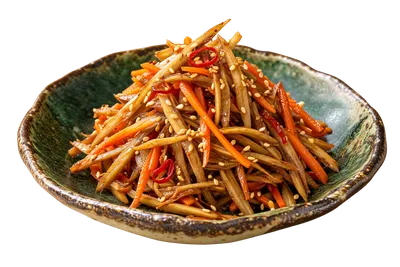
Carrot matchsticks in a glossy sweet-salty glaze, with toasted sesame
Kinpira is finely cut vegetables stir-fried with soy sauce, mirin, sake and sugar until the liquid cooks down and coats everything in a glossy glaze. Carrot is the base, and lotus root, maitake or mitsuba with roots can join it. It's a side dish that tastes just as good warm, at room temperature or cold, which is why it so often ends up in a bento through autumn and winter.
Ingredients
- 7 ozcarrotpeeled, cut into fine matchsticks (julienne)
- 7 ozmitsuba with roots (ne-mitsuba)stems cut into 3 cm pieces, roots trimmed of fine hairs and split lengthwise (optional)
- 2⅛ ozmaitake mushroomstorn into small pieces (optional)
- 3½ ozcut into thin quarter slices (optional)The thickened underwater stem of the lotus plant, run through with air channels that give every slice a flower-like pattern. Crisp, mild and faintly sweet.Substitute: There is no real substitute, since neither the pattern of holes nor the faintly starchy flavour is found elsewhere. Where only the bite matters, canned water chestnuts or jicama give a similar crunch, but they are juicier and sweeter and do not turn sticky with long braising.Read more
- 2 tbspsoy saucefor the seasoning
- 2 tbspfor the seasoningSweet Japanese rice wine for cooking that gives sauces and glazes a mild sweetness and shine.Substitute: Sake or dry sherry with some sugar, about one teaspoon per tablespoon, comes close; sweetness and shine are roughly right, but the rounded, slightly malty depth of mirin is missing.Read more
- 2 tbspcooking sake, for the seasoningJapanese rice wine, used in cooking mainly to round out flavours, tame fishy notes and add umami.Substitute: Dry sherry or Chinese Shaoxing wine come closest but bring their own stronger flavour; mirin is not a substitute because it is distinctly sweet.Read more
- 1½ tbspsugarfor the seasoning
- 1 tbspfor stir-frying or as a finishOil pressed from toasted sesame seeds, dark and strongly nutty, used by the drop as a seasoning.Substitute: There is no equivalent substitute; at a pinch, steep freshly toasted, crushed sesame seeds in a little neutral oil, which gives the roasted aroma only faintly and without the depth of the oil.Read more
- 1 tbspOilfor stir-frying
- 1 tbspsesame seedstoasted, for sprinkling
- 1togarashiseeded, finely sliced, fried in the oil (optional)
- for sprinkling, for heat (optional)A Japanese seven-spice blend, usually chili, sansho pepper, dried orange peel, sesame and nori, sprinkled over food at the table.Substitute: A homemade mix comes close: chili flakes with toasted sesame, finely grated dried orange peel, a little ground sansho or Sichuan pepper and crumbled nori. Ichimi togarashi or plain chili flakes give only the heat, without the citrus, tingle and nuttiness, so the result is noticeably flatter.Read more
Method
- Prepare the vegetablesPeel the carrot and cut it into fine matchsticks, keeping them as even as you can. If you're using lotus root, peel it and cut it into thin quarter or eighth slices; tear the maitake into small pieces. For mitsuba with roots, cut the stems into 3 cm pieces, trim the fine hairs from the roots and split them lengthwise.
- Mix the seasoningStir the soy sauce, mirin, sake and sugar together in a small bowl so the seasoning is ready to go when you need it.
- Heat the oilHeat the neutral vegetable oil, and the sesame oil if you like, in a frying pan or pot. For some heat, fry the seeded, finely sliced red chili in the oil briefly first.
- Stir-fry the vegetablesAdd the vegetables and stir-fry until they're just softened but still have some bite; this only takes a few minutes.
- Add the seasoningPour in the seasoning of soy sauce, mirin, sake and sugar and toss everything well.
- Cook down to a glazeKeep stir-frying, stirring constantly, until the liquid has almost completely cooked down and the vegetables are coated in a glossy glaze. Watch closely at this stage so the sugar doesn't catch on the bottom of the pan.
- Finish with sesameTake the pan off the heat and sprinkle the kinpira with toasted sesame seeds. If you didn't use the sesame oil for frying, drizzle it over now, and add shichimi togarashi to taste.
- ServeServe warm, at room temperature or cold.
Tips and variations
Other vegetables can go in alongside the carrot: lotus root, daikon and bamboo shoots each work well. Mitsuba with roots pairs nicely with maitake, and the two go in together. If you'd like to add burdock root (gobo) but can't find it, use salsify instead: put it in water as soon as it's cut, then cook it soft with a little extra water before the seasoning goes in. Some cooks sprinkle the sugar over the vegetables on its own first and only then add the rest of the sauce. Fresh or dried chili or shichimi togarashi bring heat. A pinch of garam masala gives it a warm, spicy edge. For a quick version, mix the carrot with the seasoning ingredients, cover the dish and microwave for 1–2 minutes. Since kinpira is good cold too, it's easy to make ahead and eat the next day as a side or in a bento.
Allergens
Contains: Cereals containing gluten, Sesame, Soybeans
These notes follow from this recipe's ingredient list. Ready-made products and brands may contain further allergens — please check the packaging yourself.
Something not right?
This recipe was put together from independent sources and checked before publishing. Even so, a mistake can slip through — an amount that does not add up, a step that does not work as written. If you spot something, write to us: we will look into it and put it right.